Holiday snack time is one of the sweetest parts of the season, and you put a lot of care into it. We did the planning homework so you can enjoy the fun part.
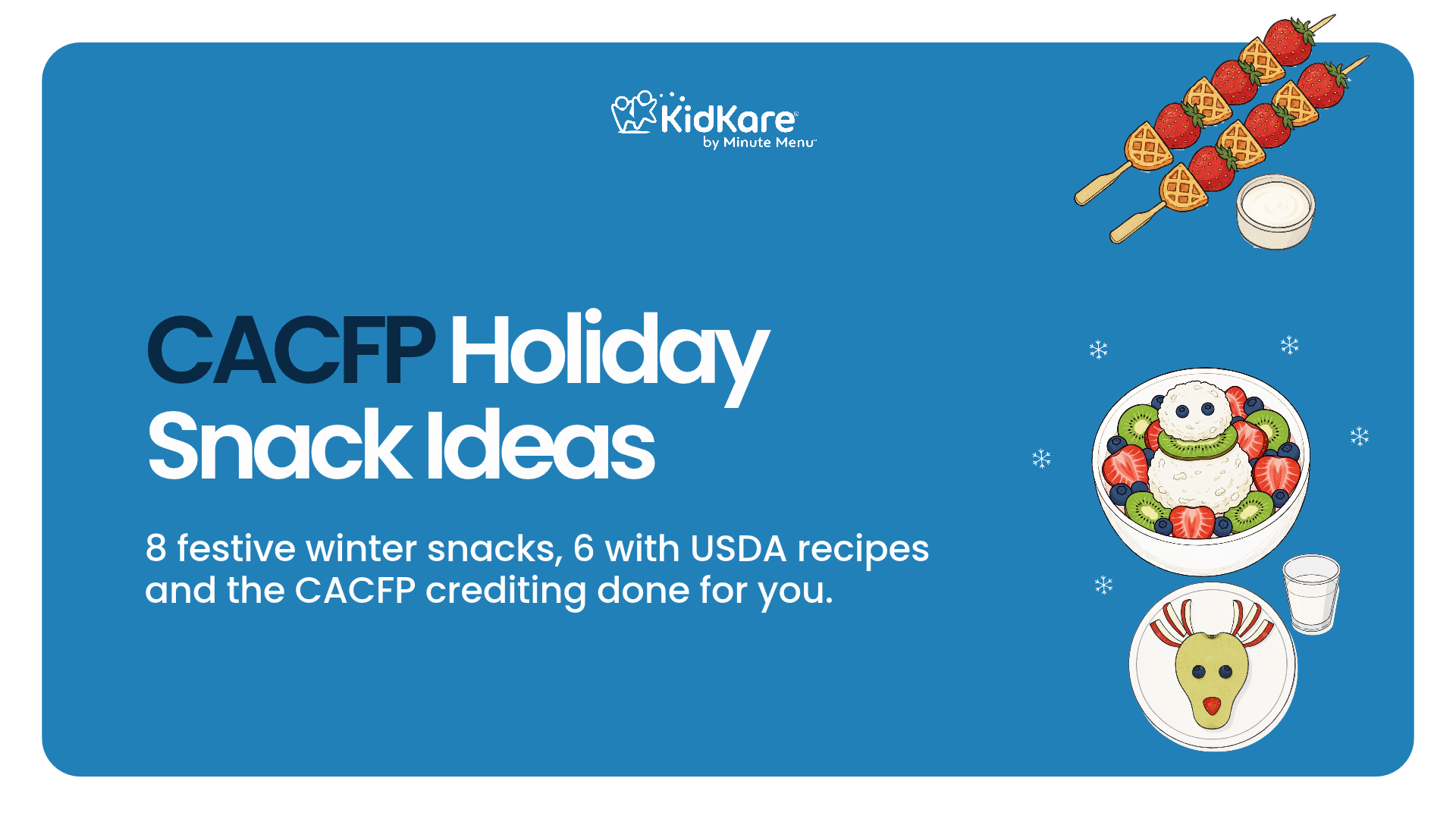
These 8 CACFP holiday snack ideas bring snowmen, reindeer and gingerbread spice to snack time, whatever your families celebrate. Six are built on USDA standardized recipes for child care, with the crediting already worked out and the recipe linked on each card. Two are no-cook snacks the kids build themselves. Every card gives the amounts to serve, so you can plan with confidence.
The short answer: a holiday snack credits in the CACFP the same way any snack does. It needs two of the five meal components (milk, meats/meat alternates, vegetables, fruits and grains), each in at least its minimum amount. For ages 1 to 5, that’s ½ cup of fruit or vegetables, ½ oz eq of grains or meat/meat alternate, or 4 fl oz of milk per component. If one component is milk or juice, make the other one a food (7 CFR 226.20(c)(3), Table 4).
Planning crafts and party games too? They’re in Holiday Season Activities and Recipes for Your Childcare Center. This post is all snacks.
✅ CACFP Snack Rules for Holiday Treats, in 30 Seconds
- Two components, full amounts. Serve two of the five components, each in at least the minimum amount. The minimums for ages 1–2 and 3–5 are the same (7 CFR 226.20(c)(3), Table 4). A topping smaller than the minimum is a bonus, not a component.
- Pair milk or juice with a food. Milk, fruit juice and vegetable juice can make up only one component of a snack. Juice must be pasteurized and full-strength, and it can be served at only one meal or snack a day (7 CFR 226.20(c)(3), Table 4).
- Muffins count as a grain; cookies don’t. Grain-based desserts don’t count toward the grains component (7 CFR 226.20(a)(4)(iii)). Muffins and other bread products do (7 CFR 226.20(a)(4)(i)(B)). That’s why the gingerbread-spice muffins below credit and gingerbread cookies don’t.
- Milk goes by age. Age 1: unflavored whole milk. Ages 2 through 5: unflavored whole, 2%, 1% or fat-free milk (7 CFR 226.20(a)(1)). So hot cocoa and other flavored milks don’t count as the milk for children under 6.
- Watch the sugar in yogurt and cereal. Yogurt can have no more than 12 g of added sugars per 6 oz (7 CFR 226.20(a)(5)(iii)(B)), and breakfast cereal no more than 6 g of added sugars per dry ounce (7 CFR 226.20(a)(4)(ii)).
- One whole grain-rich serving a day. At least one grain serving each day, across all meals and snacks, must be whole grain-rich (7 CFR 226.20(a)(4)(i)(A)). The pancakes, waffles and cranberry bread below are whole grain-rich.
- Your state and sponsor may add rules. The federal meal pattern is the starting point. State agencies can add requirements of their own (7 CFR 226.25(b)), and sponsors have their own procedures for menus, store-bought products and records. Even USDA’s recipe pages say to check with your sponsor (ICN Recipe Box). Before you serve a new recipe or product, ask your sponsor. Centers that work directly with the state: ask your state agency.
These ideas are for children 1 and older. Babies under 1 follow the infant meal pattern (7 CFR 226.20(b)). The Recipe Box’s child care recipes come in versions for ages 3 to 5 and 6 to 18, with none for ages 1 to 2. The snack minimums are the same for ages 1 to 2 and 3 to 5, so the card amounts work for toddlers too, with softer, smaller textures (see the tips below). Ages 6 and older need more: check Table 4 in 7 CFR 226.20(c)(3).
❄️ 8 Creditable Winter Snacks for Ages 1 to 5
Real recipes, crediting already done
❄️
Snow Day Pancakes: Oven-Baked Pancakes + Spiced Pears
Bake the whole-wheat batter in a loaf pan instead of flipping pancakes one by one, then spoon warm pears in pumpkin pie spice on top. USDA’s recipe credits one serving (1 pancake slice with ½ cup spiced pears) as ½ cup fruit and ½ oz eq grains: a complete snack on its own, and whole grain-rich, too.
Fruit
Grain
Get the USDA recipe →
🍬
Candy Cane Kebabs: Strawberries + Whole Grain Waffles
Red strawberries, golden waffle triangles and a maple-yogurt dip. One serving (2 kebabs: 6 strawberries and 2 waffle triangles from whole grain-rich frozen waffles of at least 1 oz each) gives ½ cup fruit and ½ oz eq grains. The dip adds ¼ oz eq meat alternate, less than a snack needs, so it’s a bonus. Pick a yogurt with no more than 12 g added sugars per 6 oz. For children under 4, skip the sticks (the recipe has a plate version) and cut the strawberries in half.
Fruit
Grain
Get the USDA recipe →
⛄
Snowman Fruit Bowls: Cottage Cheese + Winter Fruit
½ cup of kiwi, blueberries and strawberries in a bowl, topped with 2 Tbsp of cottage cheese in two small scoops. That’s a snowman, kiwi-slice scarf included. USDA’s recipe credits one bowl as ½ cup fruit and ½ oz eq meat alternate. Skip the optional granola, and cut blueberries in half for children under 4.
Fruit
Meat/Meat Alternate
Get the USDA recipe →
🎄
Cranberry Christmas Bread: Orange Cranberry Quick Bread + Clementines
A whole grain-rich quick bread with cranberries and orange that you bake the day before. One piece gives 1¼ oz eq grains (its ⅛ cup fruit is too little to count on its own). Serve it with ½ cup of clementine or mandarin orange segments, cut into small pieces for children under 4.
Grain
Fruit
Get the USDA recipe →
🥛
Gingerbread-Spice Muffins: Breakfast Muffins + Milk
Milk and muffins for Santa. USDA’s breakfast muffins bring the gingerbread flavors (ginger and cloves) along with whole-wheat flour, applesauce and shredded carrot. One muffin gives 1 oz eq grains; a snack needs ½ oz eq, so by our math half a muffin covers it. Serve with ½ cup (4 fl oz) of unflavored milk, whole milk for age 1. Muffins count as grains in the CACFP. Cookies don’t.
Grain
Milk
Get the USDA recipe →
🔥
Fireside Sweet Potatoes: Orange Glazed Sweet Potatoes + Crackers
Diced sweet potatoes simmered in an orange, ginger and cinnamon glaze, with a sprinkle of dried cranberries. ½ cup gives ½ cup vegetable. Add ½ oz eq of whole grain-rich crackers (check the package). Let the potatoes cool to warm, and chop the dried cranberries small for children under 4.
Vegetable
Grain
Get the USDA recipe →
Little hands, big winter fun
🌲
Veggie Christmas Tree: Green Veggies + Grape Ornaments
Kids lay out a tree with ½ cup of green veggies (cucumber slices, green pepper strips and soft-cooked broccoli), then hang ½ cup of red grape “ornaments.” Measure each one with a ½ cup measure. For children under 4, quarter the grapes lengthwise and use soft-cooked or thin-cut veggies.
Vegetable
Fruit
🦌
Reindeer Pears: Pear Half + Milk
A canned pear half (packed in juice), flat side down, becomes a reindeer face: thin apple slices for antlers, blueberry halves for eyes and a small piece of strawberry for the nose. Measure ½ cup of fruit in all, counting the pear, apple and berries together. Serve with ½ cup (4 fl oz) of unflavored milk, whole milk for age 1. Use thin, soft apple slices for children under 4.
Fruit
Milk
Please note: Crediting for the six recipes comes from the USDA standardized recipes in the Child Nutrition Recipe Box. The recipes are written for ages 3 to 5 and older; the snack amounts for ages 1 to 2 are the same. Amounts meet the snack minimums for ages 1 to 5 (the same for both age groups). Ages 6 and older need more: see Table 4 in 7 CFR 226.20. Store-bought crackers, waffles and yogurt vary, so check labels and the Food Buying Guide. Always check products, serving sizes and crediting with your sponsor or state agency before serving.
🧒 Serving Tips for Toddlers and Preschoolers
Cut for safety. For children under 4, cut strawberries and blueberries in half, quarter grapes lengthwise, cut clementine segments into small pieces, chop dried cranberries and slice apples thin. Skip granola, whole nuts and popcorn, and leave out the kebab sticks.
Plan for allergies. These snacks include wheat (pancakes, waffles, breads, muffins and crackers), milk (yogurt, cottage cheese, the muffins and milk) and eggs (breads and muffins). Pancake mixes and frozen waffles can hold other allergens too, so check the labels. If a child can’t have a food, swap in another food from the same component. For a disability-related meal modification, follow your sponsor’s process; a modification that doesn’t meet the meal pattern needs a medical statement (7 CFR 226.20(g)(1)).
Festive, not sugary. The fun is in the names and the shapes: bread cut with a star cookie cutter, a reindeer the kids build themselves, snowman bowls on a “snowy” white plate. Keep treats out of behavior charts, too: CACFP meals and snacks can’t be used as a reward or a punishment (7 CFR 226.20(p)).
Bake ahead. The breads, muffins and pancakes each bake in one pan and make 6 servings. Bake them the day before, and snack time is mostly done.
❓ Holiday Snack Questions, Answered
What are CACFP-creditable Christmas snacks?
Any snack with two of the five meal components in at least the minimum amounts, as long as milk and juice aren’t the only two: the same rule as the rest of the year (7 CFR 226.20(c)(3), Table 4). Festive ideas from this list: gingerbread-spice muffins with milk, cranberry Christmas bread with clementines, a veggie Christmas tree with grape ornaments, and reindeer pears with milk.
Can I serve holiday treats at a CACFP snack?
You can make snack time festive, as long as the snack itself has two creditable components in full amounts, not just milk and juice (7 CFR 226.20(c)(3), Table 4). Some holiday favorites won’t count toward those components: cookies and other grain-based desserts don’t count as the grain (7 CFR 226.20(a)(4)(iii)), and hot cocoa doesn’t count as the milk for children under 6 (7 CFR 226.20(a)(1)). The easy fix is to make the creditable foods the treat, like the snowman bowls and candy cane kebabs above. If you’d like to add a party treat that doesn’t count toward a component, ask your sponsor (or your state agency, if you work with it directly) how they handle it first.
Do holiday cookies count for CACFP?
Not toward the grains component. Cookies are grain-based desserts, which don’t count (7 CFR 226.20(a)(4)(iii)). Build the snack from two creditable components instead, like the gingerbread-spice muffin and milk above.
Does hot cocoa count as the milk at a CACFP snack?
Not as the milk component for children under 6. Age 1 needs unflavored whole milk, and ages 2 through 5 need unflavored milk (7 CFR 226.20(a)(1)). Plain milk with the reindeer pears is a creditable swap.
Is juice OK for a holiday party snack?
Yes, if it’s pasteurized, full-strength (100%) juice, it’s the only juice that day, and the snack’s other component isn’t milk (7 CFR 226.20(c)(3), Table 4).
Are snack amounts different for 1-year-olds?
No. The snack minimums for ages 1–2 and 3–5 are the same. What changes is the milk (unflavored whole milk at age 1) and the texture: cut foods small and soft (7 CFR 226.20(c)(3), Table 4).
Can my sponsor or state have different snack rules?
Yes. The federal rules are the starting point, and state agencies can add requirements of their own (7 CFR 226.25(b)). Sponsors also have their own procedures for menus, products and records. Ask your sponsor (or your state agency, if you work with it directly) before you add a new recipe or store-bought item.
📚 Free Snack Planning Resources
- Celebrate in the Winter: Recipes for Family Child Care Homes (Institute of Child Nutrition): free USDA recipes grouped for winter holidays, January’s Soup Month and February’s American Heart Month. Center cooks can use the child care centers version.
- CACFP Snack Recipes (Institute of Child Nutrition): USDA snack recipes you can filter by age, component and season. Free, no account needed.
- Let’s Make a Snack! (USDA Team Nutrition): a free snack menu planner with sample menus, checklists and 20 USDA snack recipes. USDA notes that it’s being revised for the current meal pattern, so check milk and sugar details against the rules above.
- Food Buying Guide for Child Nutrition Programs (USDA): how store-bought foods credit, including the Exhibit A Grains Tool for crackers and waffles. Free; use it as a guest or with a USDA login.
- 7 CFR 226.20, Requirements for meals (eCFR): the federal meal pattern, including the snack table.
- More snack cards from KidKare: Thanksgiving snack ideas that credit, Halloween snack ideas that credit and CACFP summer snack ideas.
- How to master CACFP meal planning: the meal pattern requirements, what trips people up and tips for building menus.
Not in the food program yet? Find a sponsor and get started for free →