We had so many great questions during our Year-End Peace of Mind webinar that we wanted to follow up with clear, easy-to-understand answers — no tax degree required.
Below, you’ll find answers from Mohamed, CPA, along with helpful guidance on how Parachute supports your bookkeeping and tax prep throughout the year.
Tax & Bookkeeping Questions (Answered by Mohamed Aalen, CPA, MBA, EA)
It depends on where the work is happening.
If the daycare is closed, you can deduct the expense, but not the time portion.
Monthly is best.
Daycare hours and space usage often change throughout the year. Tracking shared expenses like utilities month by month creates more accurate records and is easier to support if you’re ever audited.
If you’re reimbursed for meals, you should track actual food expenses.
While the IRS allows a standard meal allowance, using your real costs ensures:
The standard allowance is most helpful when you don’t have detailed records.
Common deductible categories include:
Anything used partly for business can often be deducted proportionally.
Yes. Meals served to enrolled children are generally deductible, even if you’re reimbursed through CACFP. The tax treatment depends on your program structure and reimbursement method, so consult your tax professional for your specific scenario.
You should retain:
Keep records for at least 3–7 years, depending on your state and tax advisor’s guidance.
W-2 providers typically cannot deduct business expenses on their personal return. If you operate independently (1099 or self-employed), deductions apply. Your employment status matters greatly.
Without documentation, deductions can be disallowed in an audit. Digital tools that capture and organize receipts throughout the year help prevent lost deductions and year-end stress.
It depends on how your business is structured:
Each structure has different tax implications. A childcare-experienced tax professional can ensure you file in the most advantageous way.
You can deduct:
Track:
Using a mileage log (or an app) makes this easy and audit-safe.
Yes — but documentation is key.
For any cash-paid expense, keep:
Without documentation, the expense may not hold up in an audit.
Whenever possible, make separate purchases for personal and business items.
If you do have a mixed receipt:
This makes it much easier to justify deductions later.
Use a percentage.
Estimate how much of your phone use is related to your daycare (calls, texts, apps, emails).
For example, if half of your usage is business-related, you can deduct 50% of your phone bill.
If needed, support your estimate with call logs or usage records.
Playground equipment is usually considered a long-term asset, which means it’s depreciated over time.
However, if you want to reduce your tax bill this year, you may be able to expense the full amount using Section 179, depending on your situation. A tax professional can help you decide which option makes the most sense.
Internet and cable are typically treated as utilities and deducted using your time-space percentage.
One note of caution:
Cable is only deductible if it’s directly used for daycare operations (like educational programming). Personal entertainment doesn’t qualify.
No — you can’t deduct the value of your own time.
While these activities absolutely support your business, you can’t “pay yourself” for time and deduct it. Doing so would create taxable income, which cancels out the benefit.
You can deduct expenses related to these activities (like supplies or training fees), just not the time itself.
It comes down to strategy.
Both are valid options. The right choice depends on your income and goals for the year.
Yes. CACFP reimbursements are income, but many food-related expenses remain deductible. Accurate recordkeeping ensures you don’t overpay or underreport.
The biggest challenge providers shared was keeping up with records during the year.
Tools like Parachute help you:
This turns tax season from a scramble into a simple export.
Parachute is childcare bookkeeping software built specifically for home providers, not large centers or general accounting firms.
It’s designed around the unique workflow of caring for children from your home — including Time/Space % calculations that you can organize your business bookkeeping easily. Start
Parachute brings everything together in a way that makes sense for your day-to-day work, so you can:
Along with other helpful tools like Receipt Capture, Parent Communication via Activity Log or Parent Messaging, Flexible Attendance Options, Simple Invoicing and Payments.
You can add your own.
In Parachute, go to:
Expenses → Add Business Expense → Category → Add Custom Category
This gives you flexibility while still keeping your records organized.
Yes.
From the Home dashboard, you can view reports by:
Each report has a date dropdown so you can quickly adjust your view.
Parachute uses childcare-specific categories that are already aligned to IRS forms.
As long as you record expenses consistently, Parachute organizes everything for you. At tax time, you can generate:
These reports are ready to share with your tax professional.
Your Time/Space Percentage determines how much of your home expenses can be deducted for your childcare business. It’s based on:
This percentage is applied to shared costs like rent, mortgage interest, utilities, insurance, and repairs—often unlocking thousands in legitimate deductions.
Yes. You can deduct the business portion of:
These are multiplied by your Time/Space Percentage.
If the loan funded improvements used for your childcare business, the interest portion may be deductible based on your Time/Space Percentage. Keep documentation showing how the funds were used.
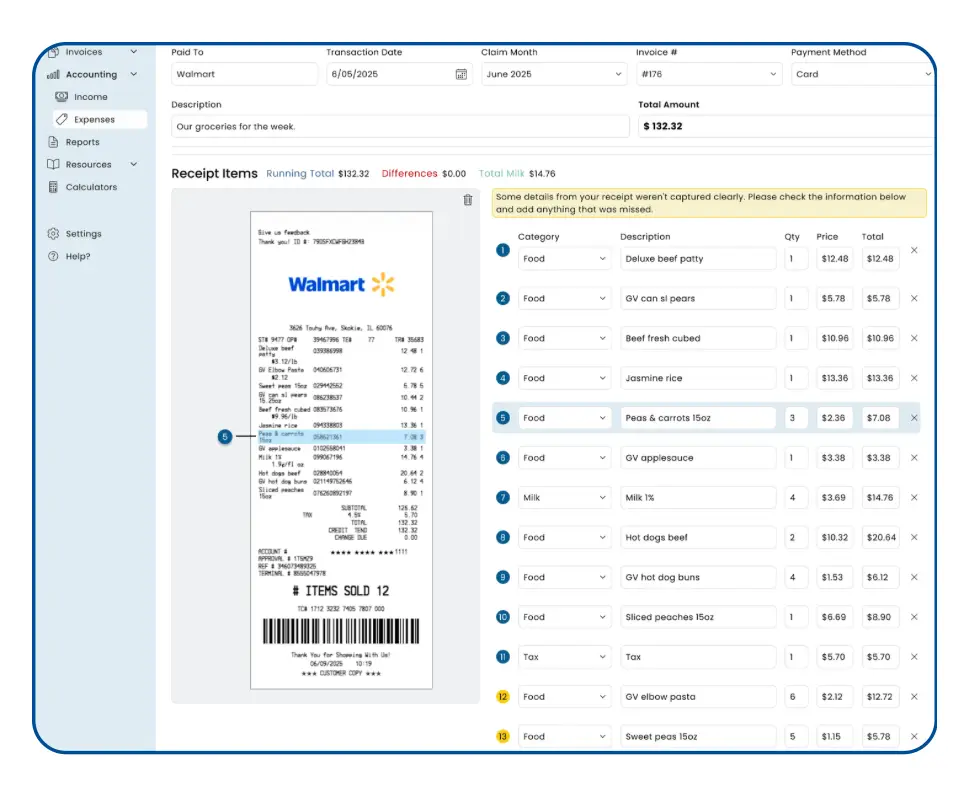
When you enter an expense, you choose how it’s used:
Parachute automatically applies the correct calculation and includes the expense in the right reports — no manual math required.
When you enter an expense, you choose how it’s used:
You decide at entry.
Each expense can be marked as:
This keeps personal and business expenses clearly separated while still capturing what’s deductible.
Payments are handled through ParaPay, Parachute’s secure payment system.
When you activate ParaPay, you link your bank account through a trusted payment partner so:
It depends on the type of provider.
You have options — learn at your own pace.
New users get access to:
You also get live and recorded webinars throughout the year, including sessions focused on onboarding, best practices, and seasonal topics like tax preparation, in Tax Season Toolkit.
A video library with recorded training sessions
A Get Started page inside Parachute with guided walkthrough videos
A comprehensive Parachute Knowledge Base with step-by-step articles covering common scenarios and questions
You don’t have to do everything perfectly — you just need systems that make it easier to stay organized over time.
That’s what good bookkeeping (and the right tools) are meant to support.
If you missed the webinar or want to dive deeper, check out our upcoming sessions or explore Parachute resources anytime.