In January 2026, USDA’s Food and Nutrition Service held its first webinar in a new training series focused exclusively on the serious deficiency process in the Child and Adult Care Food Program. The message from FNS leadership was unmistakable: program integrity is a top priority in 2026, and the serious deficiency process is the primary tool for enforcing it.
For CACFP sponsors—whether you manage a network of family child care homes, oversee affiliated centers, or serve as a third-party sponsoring organization for independent sites—understanding the serious deficiency process isn’t optional. It’s foundational to protecting your program, your providers, and the families you serve.
This guide breaks down the six steps of the SD process, explains what triggers it, and shows how proactive sponsors use compliance tools to prevent serious deficiencies from happening in the first place.
The January 2026 webinar opened with remarks from Deputy Under Secretary Patrick Penn, who drew a direct line between program integrity and the mission of child nutrition programs. His core message was clear: the serious deficiency process exists to ensure that institutions comply with program rules—and those that can’t or won’t come into compliance don’t get to participate.
This emphasis comes at a time when large-scale CACFP fraud cases have made national news, eroding public trust in the program. USDA leadership has made it clear that state agencies are expected to use the serious deficiency process actively—not as a last resort, but as a standard tool for addressing non-compliance.
What this means for sponsors: State agencies will be scrutinizing your program more closely. The bar for documentation, corrective action, and compliance has been raised. Sponsors who rely on manual processes, paper records, or inconsistent monitoring practices face elevated risk.
According to USDA’s Food and Nutrition Service, serious deficiency is a formal status assigned to an institution (a sponsoring organization or independent center) that has been found to be non-compliant with one or more CACFP requirements. As outlined in the January 2026 FNS webinar on serious deficiency, the SD process provides a structured, six-step pathway for state agencies to address serious violations while ensuring due process for the institution and its responsible principals and individuals (RPIs).
It is important to understand that, per USDA regulations, the SD process does not mean immediate termination. Institutions are given opportunities to correct serious problems before any action to terminate their agreement is taken. However, as the January 2026 FNS webinar emphasized, if an institution is unwilling or unable to correct the deficiencies, the process leads to termination, disqualification, and placement on the National Disqualified List (NDL)—a nationwide database that prevents disqualified entities from participating in any state.
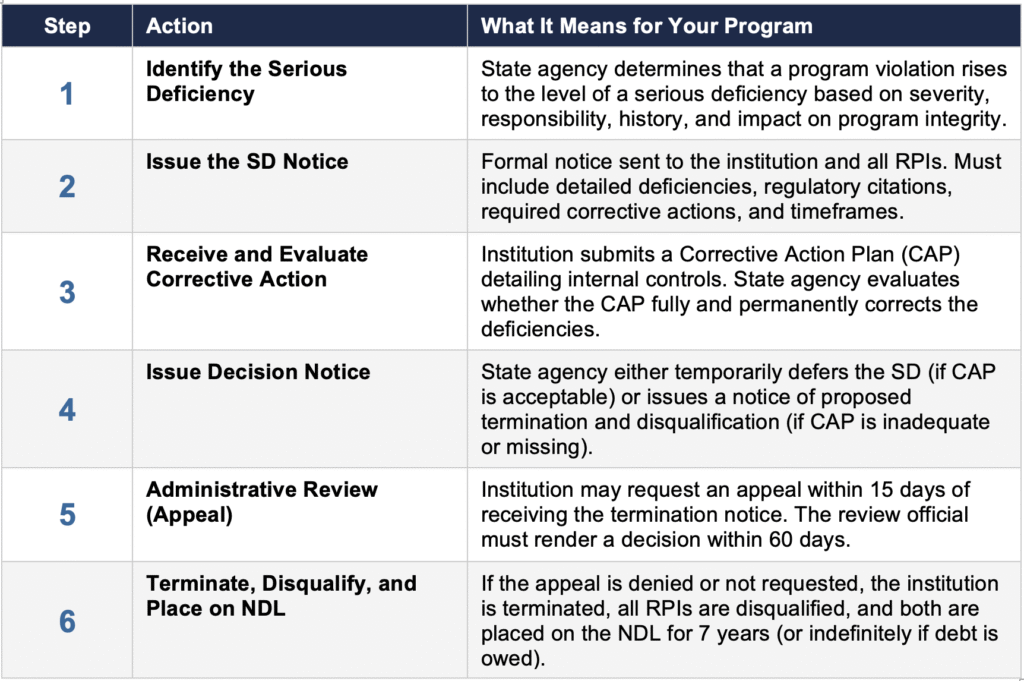
Not every finding during a monitoring review rises to the level of a serious deficiency. According to USDA’s January 2026 FNS webinar, state agencies have discretion, and FNS outlined several factors they consider when making this determination.
Severity of the problem: Is the non-compliance minor or substantial? Is it systemic or an isolated event? Even minor problems may be serious if they are systemic, and some problems are serious even if they occur only once.
Degree of responsibility: Was the violation an inadvertent error by an otherwise responsible institution? Is there evidence of negligence, conscious indifference, or outright deception?
Participation history: Is this the first time the institution has had problems, or has non-compliance occurred repeatedly?
Impact on program integrity: Do the violations undermine the purpose of CACFP, such as misusing funds for non-program purposes? Or are they administrative errors that don’t compromise the program’s core mission?
The FNS presenters walked through several scenarios that illustrate how state agencies apply discretion. Here are three takeaways every sponsor should understand.
Missing meal documentation is serious. If an institution fails to maintain product labels, standardized recipes, or child nutrition labels to support that meals meet program requirements, the finding can rise to the level of serious deficiency—especially when multiple days or meals are affected. As noted in the USDA FNS Serious Deficiency Handbook, CACFP regulations specifically list claiming reimbursement for meals that don’t meet meal pattern requirements as a serious deficiency.
Missing financial records are serious. If an institution cannot provide receipts for goods purchased with CACFP funds, this is a clear serious deficiency. Per USDA CACFP regulations, institutions must maintain copies of all invoices, receipts, and records documenting that CACFP funds are used solely for program purposes.
Context matters for procurement violations. A sponsoring organization that failed to solicit bids for a food service management company contract—but only because the previous vendor went out of business unexpectedly, and the organization had an 8-year clean history—may not rise to the level of serious deficiency. The state agency has discretion to provide technical assistance instead, especially when the violation alone doesn’t compromise program integrity.
Financial mismanagement is always serious. As presented in the January 2026 FNS webinar scenario, a sponsoring organization that fails to disburse payments to providers within the required timeframe—with confirmed six-week payment lapses—will trigger the SD process. Per USDA regulations, sponsors must disburse payments within required timeframes, and failure to do so compromises program integrity and requires immediate state agency intervention.
If your program receives a serious deficiency notice, the corrective action plan (CAP) is your opportunity to demonstrate that you can fully and permanently correct the problem. According to USDA’s FNS guidance on acceptable corrective action plans, the CAP must include documentation of the corrective action taken and, for each area cited as a basis for the serious deficiency, the institution’s internal controls to ensure the serious deficiency is fully and permanently corrected. The January 2026 FNS webinar was explicit about what state agencies expect in an acceptable CAP.
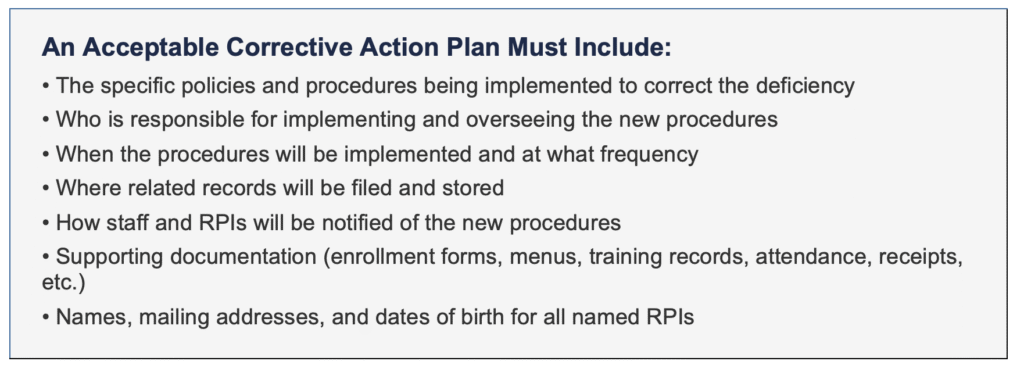
As stated by FNS presenters during the January 2026 webinar, institutions “can never be too detailed” in their corrective action plans. The more information you provide, the stronger your position. Vague responses—such as stating you will “use online resources” to fix menu issues without specifying which resources or including staff training—will be rejected.
Per USDA regulations, maximum 30 days for corrective action when the state agency determines false or fraudulent claims, false information, or concealed criminal background.
Per USDA regulations, maximum 90 days for corrective action for all other serious deficiencies
Per USDA regulations, more than 90 days for long-term revisions of management system or processes. Plan must be submitted and approved within 90 days.
According to USDA’s FNS Serious Deficiency Handbook, the NDL is the ultimate consequence of the SD process. Once placed on the NDL, an institution and its RPIs cannot participate in CACFP in any state for 7 years—or indefinitely if a debt is owed. Per USDA regulations, state agencies and sponsoring organizations are required to check the NDL before approving any new applicants.
According to USDA guidance, early removal is possible but not guaranteed. Individuals can submit a corrective action plan and pay any outstanding debt to request removal, but state agencies and FNS regional offices are not required to approve these requests.
The NDL is used exclusively for CACFP eligibility verification. It does not affect an individual’s ability to obtain employment outside of CACFP or secure loans.
The best approach to the serious deficiency process is to never enter it. Here’s how sponsors who use compliance-first systems protect their programs.
Automated edit checks catch errors before claims are submitted. Systems with built-in claim validation—checking for missing meal components, attendance mismatches, capacity violations, and incomplete documentation—prevent the types of claim errors that trigger serious deficiency findings. When 250+ automated checks run on every claim before it reaches the state agency, errors are caught at the source.
Digital enrollment eliminates paper gaps. Missing or incomplete enrollment forms and income eligibility statements are among the most common serious deficiency triggers. Digital enrollment systems that send forms directly to parents, auto-verify free/reduced/paid status, and alert sponsors to upcoming expirations eliminate these gaps before they become findings.
Menu compliance is built into every meal. Sponsors who distribute master menus with built-in USDA meal pattern tracking and food rules enforcement don’t discover meal pattern violations during state reviews—because non-creditable meals are flagged or prevented at the point of entry.
Cloud-stored records provide instant documentation. When a state agency asks for receipts, enrollment history, or claim details from two years ago, sponsors with cloud-stored records answer in seconds. The webinar emphasized that institutions must maintain financial records to support every CACFP dollar—cloud storage makes that standard effortless.
Digital monitoring tools ensure consistent reviews. Custom review forms, e-signatures, and automated scheduling mean monitors conduct thorough, standardized reviews at every site. Findings are documented immediately, corrective actions are tracked in real time, and patterns are visible across the entire network.
Observer Mode enables proactive coaching. When sponsors can see exactly what their sites see—menus, claims, enrollment data—they can identify potential issues and coach providers before a state review ever happens. Remote support without data risk turns compliance from reactive enforcement into proactive partnership.
USDA has signaled clearly that 2026 is a year of heightened program integrity focus. The serious deficiency process is the enforcement mechanism, and state agencies are being trained—and expected—to use it.
For sponsors, the choice is straightforward: invest in the systems, documentation, and workflows that prevent serious deficiencies, or face the consequences of a process that can terminate your agreement, disqualify your responsible principals, and place your organization on a national list for seven years.
KidKare was built to keep sponsors on the right side of this equation. With 250+ automated edit checks, digital enrollment via eForms, USDA-aligned menu tools, cloud-stored records, and digital monitoring capabilities, KidKare helps sponsors prevent the errors that trigger serious deficiencies—before they ever reach a state reviewer’s desk.
Aligned with USDA Guidelines
Meal patterns, reimbursement rates, and program rules are continuously maintained to reflect current CACFP requirements.
Secure, Long-Term Data Retention
Access years of claims, child records, and documentation instantly — without managing paper binders or storage rooms.
See how sponsors modernize compliance → 📞 Schedule a 15-min discovery call.
Sources
USDA FNS — Serious Deficiency in the CACFP (January 2026 Webinar): https://www.cacfp.org/2026/01/28/serious-deficiency-in-the-cacfp/
USDA FNS — Serious Deficiency, Suspension, & Appeals Handbook: https://www.fns.usda.gov/cacfp/serious-deficiency-suspension-appeals-state-agencies-and-sponsoring-organizations
USDA FNS — Guidance on Acceptable Corrective Action Plans and NDL Procedures: https://www.fns.usda.gov/cacfp/child-and-adult-care-food-program-guidance-serious-deficiency-process-and-acceptable-corrective
USDA FNS — Promoting Stronger Program Integrity and Oversight in the CACFP (February 2026 Memo): https://www.cacfp.org/2026/02/12/promoting-stronger-program-integrity-and-oversight-in-the-cacfp/
USDA FNS — SD Process Proposed Rule (February 2024): https://www.fns.usda.gov/cn/fr-022124
USDA FNS — Q&As on Serious Deficiency Process: https://www.fns.usda.gov/cacfp/qas-state-agency-oversight-tools-sponsor-oversight-tools